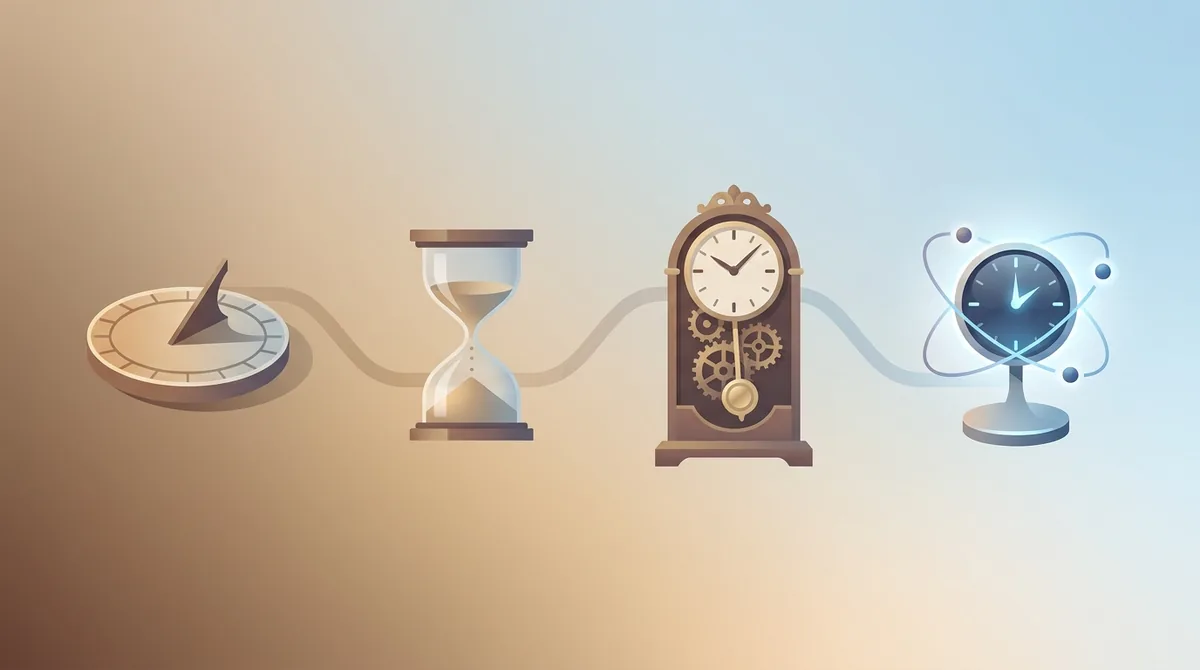
Measuring the Unmeasurable
Time is the one resource every civilization has tried to pin down, and for most of human history the effort was surprisingly imprecise. A farmer needed to know the season, a priest the hour of a ritual, a sailor the moment of high tide. Yet the tools available to answer those questions ranged from a shadow on the ground to a dripping jar of water. The story of timekeeping is the story of humanity slowly wrestling a slippery abstraction into ever-finer numbers, moving from devices accurate to the nearest hour to clocks that will not lose a second in the lifetime of the universe.
What follows is a short history of that journey, from the sundials of ancient Egypt to the optical lattice clocks humming in today's laboratories.
Shadows and Sunlight: The First Clocks
The earliest timekeepers looked up rather than down. As the sun crossed the sky, the shadow it cast swept across the ground in a predictable arc, and any tall object could serve as a pointer. The ancient Egyptians raised towering obelisks as early as around 3500 BCE, and their moving shadows divided the daylight into recognizable parts. By roughly 1500 BCE, Egyptians were using portable shadow clocks — a horizontal bar with a raised crosspiece that cast a shadow along a marked scale.
These devices matured into the sundial, which the Greeks and Romans refined by understanding that the shadow-caster, or gnomon, had to be angled toward the celestial pole to keep the hours consistent through the year. Sundials were elegant and required no maintenance, but they shared two obvious flaws: they were useless at night and helpless under clouds. Time, it turned out, could not depend on the weather.
Water That Keeps Time
The solution was to measure something more reliable than sunlight: the steady flow of water. The water clock, or clepsydra (Greek for "water thief"), first appeared in Egypt around the reign of Amenhotep III in the 14th century BCE. In its simplest form, water dripped at a near-constant rate from a marked vessel, and the falling level indicated the passing hours.
Different cultures pushed the idea in different directions. In Greece, engineers added floats, gears, and dials, and the clepsydra became a fixture of the courts, where it timed the speeches of orators. In China, the technology reached remarkable heights. In 1088 CE, the polymath Su Song completed a water-driven astronomical clock tower more than ten metres tall, incorporating an escapement mechanism that released water in measured pulses to turn the works — arguably a conceptual ancestor of the mechanical clocks to come.
Water clocks freed timekeeping from the sun, allowing the hours to be counted through the night and in any weather. But water freezes, evaporates, and flows faster when the vessel is full than when it is nearly empty. Accuracy remained stubbornly out of reach.
The Mechanical Revolution
The decisive break came in medieval Europe. Sometime in the late 13th century, an unknown craftsman — the invention has no single named inventor — devised the verge escapement, and with it the mechanical clock was born.
The principle was ingenious. A falling weight provided steady power, but the trick was releasing that power in controlled increments rather than letting it run away all at once. The verge escapement used a horizontal bar (the foliot) with weights on each end that rocked back and forth, engaging and releasing a toothed wheel with each swing. Every oscillation let the gear train advance by a single, measured step. This tick-tock — the audible signature of the escapement — is arguably the defining sound of mechanical civilization.
These early clocks, installed in cathedral and town towers across the 14th century, were crude by modern standards, often drifting by fifteen minutes or more a day. They frequently had no dial at all, existing only to strike a bell (the word clock derives from the Latin clocca, meaning bell). Still, they represented something profound: for the first time, a machine measured time by its own internal motion, wholly independent of sun, water, or season.
Huygens and the Pendulum
For nearly four centuries, mechanical clocks remained frustratingly inaccurate, because the foliot had no natural rhythm of its own — it swung as fast or slow as the mechanism pushed it. The breakthrough came in 1656, when the Dutch scientist Christiaan Huygens built the first practical pendulum clock.
Huygens drew on Galileo's earlier observation that a pendulum of a given length swings with a remarkably constant period regardless of how wide the swing. By harnessing that natural regularity as the clock's timekeeping element, Huygens transformed the field almost overnight. Where the best mechanical clocks had erred by many minutes a day, his pendulum clocks were soon accurate to within about fifteen seconds — and later refinements pushed error below a single second per day.
The leap was staggering: roughly a hundredfold improvement in a single stroke. Pendulum clocks would remain the most accurate timekeepers in the world for the next 270 years, standing in observatories and defining the official time of nations.
The Longitude Problem
Accurate clocks were not merely a scientific curiosity; they held the key to one of the great practical challenges of the age — finding one's position at sea. A ship's latitude could be read from the height of the sun or stars, but longitude had no such easy solution. Because the Earth turns 15 degrees of longitude every hour, a sailor who knew the exact time at a fixed reference point, and compared it to local noon aboard ship, could calculate how far east or west they had sailed. The problem was that no clock could keep accurate time on a pitching, temperature-swinging, salt-sprayed ship. Pendulums were useless on a rolling deck.
The stakes were deadly. Ships ran aground and fortunes sank for want of an answer, and in 1714 the British Parliament offered a vast prize for a reliable solution. Enter John Harrison, a self-taught Yorkshire carpenter and clockmaker who devoted his life to the problem. Over decades he built a series of marine chronometers, culminating in his masterpiece, H4, completed in 1759. Compact and jewel-like, it used a fast-beating balance wheel immune to the ship's motion. On a 1761 voyage to Jamaica, H4 lost only about five seconds over 81 days — an accuracy that seemed almost miraculous. Harrison had solved the longitude problem and, in doing so, made the reliable global navigation of the following centuries possible.
Quartz: Time Without Gears
The next revolution abandoned mechanical motion altogether. In 1927, engineers Warren Marrison and J. W. Horton at Bell Telephone Laboratories built the first quartz clock. When an electric current is applied to a quartz crystal, it vibrates at an extraordinarily stable frequency — a property called piezoelectricity. By counting those vibrations electronically, a clock could keep time with no swinging pendulum and no escapement to wear.
Quartz clocks quickly surpassed the finest pendulum instruments, and by the mid-20th century they had become the new laboratory standard. Their real triumph, though, was miniaturization. By the 1970s, quartz movements were cheap and small enough to fit inside a wristwatch, putting timekeeping more accurate than any 19th-century observatory clock on the wrists of ordinary people. The quartz watch on your arm today is a direct descendant of that 1927 breakthrough.
The Atomic Age
Even quartz has limits, as crystals vary slightly with temperature and age. The ultimate reference had to come from nature itself — from the unchanging behavior of atoms. In 1955, Louis Essen and Jack Parry at the National Physical Laboratory in the United Kingdom built the first accurate caesium atomic clock. It measured time by the resonant frequency of caesium-133 atoms, which absorb and emit microwave radiation at a frequency so consistent it is essentially fixed by the laws of physics.
The atomic clock was so much better than anything before it that it forced a redefinition of time itself. For millennia the second had been defined by the Earth's rotation — a fraction of a day. But the Earth is a wobbly, gradually slowing timekeeper. So in 1967, the international community formally redefined the SI second as exactly 9,192,631,770 oscillations of the radiation from a caesium-133 atom. For the first time, the fundamental unit of time was untethered from the heavens and anchored to the atom.
The precision of atomic time soon reshaped other units too. In 1983, the metre was redefined as the distance light travels in a vacuum in 1/299,792,458 of a second. Because the speed of light is now treated as a fixed constant of nature, distance itself is defined in terms of time. That constant is genuinely enormous — light covers roughly 1.08 billion km/h (speed of light to km/h) or about 671 million mph (speed of light to mph) — which is why a fraction of a single second is enough to span a whole metre and far beyond.
The Future: Clocks for the Age of the Universe
Timekeeping did not stop with caesium. Today's frontier belongs to optical lattice clocks, which trap thousands of atoms — often strontium or ytterbium — in a grid of laser light and read their oscillations at optical rather than microwave frequencies. Because they tick hundreds of thousands of times faster than caesium, they can be measured with staggering precision.
The best of these clocks are so stable that they would neither gain nor lose a single second over billions of years — longer than the current age of the universe. Such accuracy is not idle showmanship. It is precise enough to detect the tiny slowing of time predicted by Einstein when a clock is raised just a few centimetres higher in Earth's gravity, opening the door to using clocks as sensors for geology, navigation, and fundamental physics. A future redefinition of the second, based on an optical transition rather than caesium, is widely expected in the coming years.
From the Shadow to the Zone
From an obelisk's shadow to a lattice of trapped atoms, the arc of timekeeping has bent relentlessly toward precision. Each leap — the escapement, the pendulum, the chronometer, quartz, the atom — brought the world into tighter synchrony. That precision is the invisible scaffolding beneath modern life: it coordinates satellites, timestamps financial trades, and keeps the internet in step across continents.
It also underlies something you use every day. The neatly organized time zones that let you schedule a call across the globe or catch a flight on the far side of the world are only possible because we can all agree, to a fraction of a second, on what time it actually is.
Frequently Asked Questions
What was the first device used to tell time?
The earliest timekeepers were shadow-based. Ancient Egyptian obelisks, raised as far back as around 3500 BCE, cast moving shadows that divided the day, and by about 1500 BCE Egyptians used portable shadow clocks. These evolved into the sundial, refined by the Greeks and Romans. Their limitation was obvious: they only worked in daylight and clear skies.
Who invented the pendulum clock?
The Dutch scientist Christiaan Huygens built the first practical pendulum clock in 1656, drawing on Galileo's observation that a pendulum swings with a constant period. It improved accuracy roughly a hundredfold, from many minutes of error per day to seconds, and pendulum clocks remained the world's most accurate timekeepers for over 250 years.
How did clocks help sailors find their position?
Because the Earth rotates 15 degrees of longitude every hour, a sailor who knows the exact time at a fixed reference point can compare it to local noon aboard ship to calculate longitude. John Harrison's marine chronometer H4, completed in 1759, kept time accurately enough at sea to solve this "longitude problem," losing only about five seconds over an 81-day voyage.
How is a second defined today?
Since 1967, the SI second has been defined as exactly 9,192,631,770 oscillations of the radiation emitted by a caesium-133 atom. This replaced the older definition based on the Earth's rotation, which was too irregular. The first accurate caesium atomic clock was built by Louis Essen and Jack Parry in 1955.
What is the most accurate clock ever made?
The most accurate clocks today are optical lattice clocks, which trap atoms such as strontium or ytterbium in laser light and read their optical-frequency oscillations. The best of them are stable enough to neither gain nor lose a single second over billions of years — longer than the age of the universe.