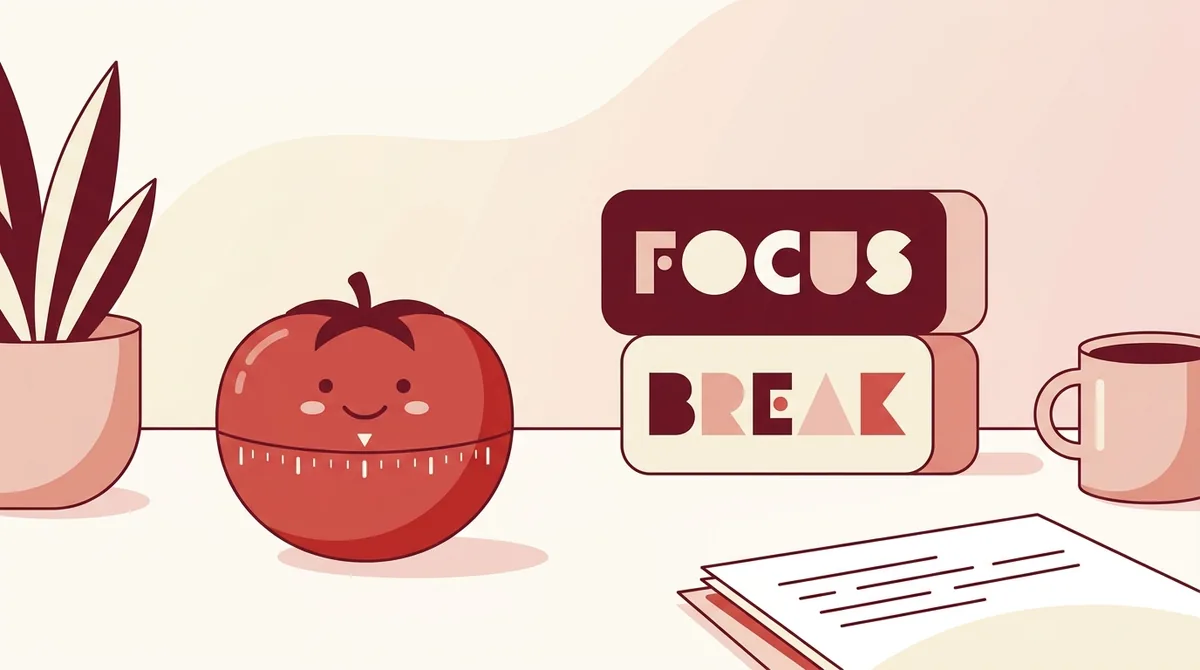
Why a Kitchen Timer Beats a To-Do List
Most productivity advice tells you to work harder. The methods that actually stick do the opposite: they shrink the work into pieces small enough that starting feels easy and stopping feels earned. The oldest and most famous of these is the Pomodoro Technique, and it began with a tomato.
This guide starts there, then walks through five more methods you can put to work today. None of them require an app, a subscription, or a system to learn. Most need nothing more than a way to count down a few minutes.
The Pomodoro Technique
In the late 1980s, a university student named Francesco Cirillo was struggling to focus. He grabbed a tomato-shaped kitchen timer, wound it to a few minutes, and challenged himself to study until it rang. Pomodoro is Italian for tomato, and the name stuck to the method.
The structure is simple:
- Pick one task.
- Set a timer for 25 minutes and work on nothing else.
- When it rings, take a 5-minute break.
- After four pomodoros, take a longer break of 15 to 30 minutes.
Each 25-minute block is one "pomodoro." You don't check email, glance at your phone, or switch tasks inside it. If a distraction pops into your head, jot it on a scrap of paper and return to work.
Why It Works
The technique borrows its power from a few quirks of human attention:
- Urgency. A ticking countdown turns an open-ended task into a small, winnable race. Parkinson's Law says work expands to fill the time available, so a hard 25-minute limit forces momentum.
- Single-tasking. The rule that you touch only one task per pomodoro kills the hidden tax of context-switching, which quietly drains focus every time you jump between things.
- Guilt-free breaks. Because rest is scheduled and earned, you stop resting on it. The break is part of the method, not a failure of willpower.
- It defeats procrastination. The hardest part of any task is starting. "Just do 25 minutes" is a small enough promise that your brain stops negotiating and begins.
How to Start
You need almost nothing. Clear your desk, pick the one thing that matters most, and start a timer for 25 minutes. That's the entire setup cost. Keep a pen and paper nearby to capture stray thoughts, and resist the urge to extend a pomodoro when you're "on a roll" — the rhythm of stopping is what keeps you fresh for the next one.
If 25 minutes feels too long at first, start at 15 and build up. The exact number matters far less than the loop: focus, break, repeat.
Five More Methods That Actually Work
Pomodoro is a rhythm. The methods below are about what you work on and when — the decisions Pomodoro leaves to you. Combine them freely; many people time-block their day and run pomodoros inside each block.
Time Blocking
Instead of a to-do list that floats through your day, give every task a home on the calendar. Block 9:00 to 10:30 for deep work, 10:30 to 11:00 for email, and so on. When a block ends, you move on.
How to do it: The night before or first thing in the morning, look at your open tasks and assign each one a specific window. Batch similar work together — all your calls in one block, all your writing in another. The discipline is protecting the blocks: treat them like meetings you can't cancel. Time blocking works because a decision made once, in advance, doesn't have to be re-made a dozen times while you're tired and tempted.
Timeboxing
Time blocking says when you'll do a task. Timeboxing adds a hard cap on how long. You give a task a fixed limit — "one hour on this report, no more" — and when the box closes, you stop, done or not.
How to do it: Estimate how long a task truly deserves, not how long it could absorb. Set an alarm for that limit and commit to it. The magic is in the stopping: a timebox forces you to ship something "good enough" rather than polishing forever. It's especially useful for perfectionists and for tasks with no natural finish line, like research or design tweaks.
The 52/17 Rule
This one comes from workplace data on when people are most productive: the highest performers tended to work in bursts of roughly 52 minutes, followed by 17 minutes of genuine rest. It's Pomodoro's longer-form cousin, suited to work that needs a longer runway to get deep.
How to do it: Set a multi-timer to run the 52-minute focus and 17-minute break back to back, or simply track your session with a stopwatch and glance at it. During the 17 minutes, actually leave the work — walk, stretch, step outside. Scrolling your phone doesn't count as recovery. The longer cycle suits programming, writing, and analysis, where 25 minutes can feel like it ends just as you've warmed up.
The Eisenhower Matrix
Named for a president who supposedly said, "What is important is seldom urgent, and what is urgent is seldom important," this method sorts tasks by two questions: Is it urgent? Is it important?
That gives you four boxes:
| Urgent + Important Do it now. |
Important, not urgent Schedule it. |
| Urgent, not important Delegate it. |
Neither Delete it. |
How to do it: Dump every task onto one list, then tag each with a box. The revelation for most people is how much lives in "urgent but not important" — the interruptions and small fires that feel productive but move nothing forward. The goal is to spend more time in the "important, not urgent" quadrant, where planning and deep work quietly prevent tomorrow's emergencies.
Eat the Frog
Mark Twain is often credited with the idea: if the first thing you do each morning is eat a live frog, you can go through the day knowing the worst is behind you. Your "frog" is the task you're most likely to avoid — usually the biggest and most important one.
How to do it: The night before, name tomorrow's frog. Then do it first, before email, before meetings, before your willpower is spent. Your energy and attention are highest in the morning; spend them on what matters most, not on clearing trivial tasks to feel busy. When the hardest thing is done by 10 a.m., everything after feels light.
A close relative — the Ivy Lee Method: At the end of each day, write down the six most important things to accomplish tomorrow, in priority order. The next day, work them top to bottom, finishing one before starting the next. Anything unfinished rolls to the next day's list. Six is the cap — it forces you to choose, and the strict order removes the daily paralysis of "what should I do now?"
Picking One and Starting Today
The worst move is to spend a week researching methods instead of doing the work. Every technique here shares the same core: reduce decisions, protect your attention, and make starting easy.
If you're not sure where to begin, use this rule of thumb. Struggle to start? Run a Pomodoro. Struggle to stop? Use timeboxing. Struggle to know what to work on? Try the Eisenhower Matrix or the Ivy Lee list. Struggle with one dreaded task? Eat the frog first thing tomorrow.
Pick exactly one and use it for a full week before you judge it. Systems fail when we treat them as new hobbies instead of tools. The tool only works when it's boring, repeatable, and running in the background of a day you actually spent doing the work.
You already have everything you need. Choose your method, set a timer, and start your first block now — the tomato is optional.
Frequently Asked Questions
Is 25 minutes the "correct" length for a Pomodoro?
It's the classic length, but not sacred. Cirillo chose it because it was long enough for real progress and short enough to feel manageable. If your work needs deeper immersion, try the 52/17 rhythm; if you're battling severe procrastination, start with 15-minute blocks. The loop matters more than the exact number.
What do I do if I get interrupted mid-Pomodoro?
The classic advice is to protect the block. If the interruption can wait, jot it on a notepad and keep working. If it genuinely can't — a real emergency — stop the timer and treat that pomodoro as void, then start a fresh one when you're back. The point is to keep each block clean, not to punish yourself.
Can I combine these methods?
Yes, and most people should. A common stack is to time-block your calendar, timebox individual tasks within each block, and run pomodoros for the deep-focus stretches. Eat the frog and the Ivy Lee list handle what you tackle; the timing methods handle how you do it.
Do I need a special app to do any of this?
No. Every method here predates the smartphone. A countdown, a piece of paper, and the discipline to follow the rule are enough. A simple online timer, stopwatch, or alarm covers every technique in this guide.
How long before a method starts working?
Give it a full week of honest use. The first day or two feel awkward because you're building a new habit, not just trying a trick. By the end of a week you'll know whether the rhythm fits your work — and if it doesn't, you'll switch with real evidence instead of a first impression.
Ready to try it? Open a timer and start your first focused block today.