You Keep Seeing Week Numbers. What Are They For?
You glance at a calendar and notice a column of numbers running down the side: 1, 2, 3, all the way to 52 or 53. Those are week numbers, and they answer a simple question: which working week of the year does this date fall into? Week numbers are used to name a whole block of days with a single label, and the people who use them the most are manufacturing planners, logistics managers, and nearly everyone in Nordic and Central European countries. A supplier promising delivery in week 12 does not care whether that week starts on a Monday or a Sunday, as long as both sides agree on the count. That agreement is the whole point.
The Standard That Makes Week Numbers Work
The international rulebook is ISO 8601. Under this standard, weeks start on Monday. Week 1 is the week that contains the first Thursday of the year, which is the same as the week containing 4 January. That rule solves a messy problem: what do you do with the days between New Year and the first full week? ISO 8601 says those days belong to the year whose first Thursday they fall into. It is clean, predictable, and language-neutral. An ISO year has either 52 or 53 weeks. A year gets 53 weeks when it starts on a Thursday, or when it is a leap year that starts on a Wednesday. 2020 had 53 weeks. 2026 has 53 weeks. The next one after 2026 is 2032.
The Edge Case That Trips Everyone Up
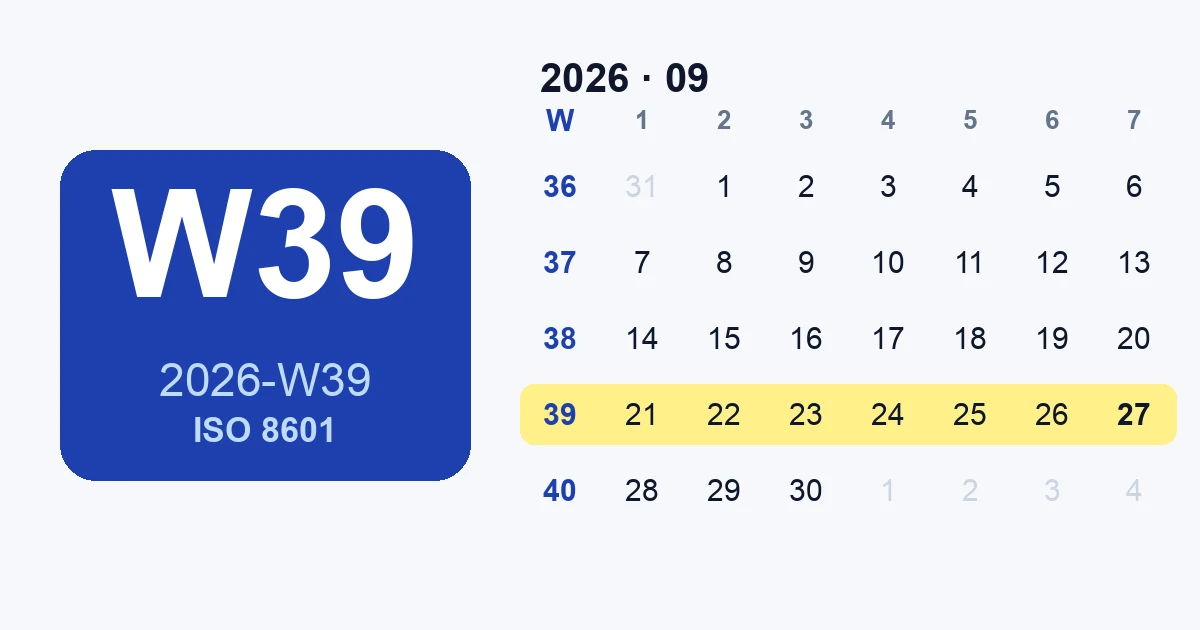
Days at the edge of the year can belong to the neighbouring ISO year. That is not a bug. It is the feature that keeps the system consistent. 1 January 2027 is a Friday, so it sits in week 53 of 2026. 31 December 2024 was a Tuesday, so it fell in week 1 of 2025. If you label a date near New Year, you must use the ISO year, not the calendar year. A spreadsheet that shows 1 January 2027 as week 1 of 2027 is wrong. The ISO notation makes the difference clear: 2026-W39 is the 39th week of 2026, and 2026-W39-7 is the Sunday of that week. Sunday 27 September 2026 is 2026-W39-7. The next day, Monday 28 September 2026, is 2026-W40-1. Check your data around New Year. It is the most common place week-number logic breaks.
Who Uses Week Numbers in Everyday Life
In the Nordic countries, people say week 32 in ordinary conversation. Printed calendars there show week numbers as standard. In Germany, Austria and Switzerland, Kalenderwoche (KW) is the default for business meetings, delivery dates, and trade fair planning. The Netherlands and Belgium use week numbers heavily in business and school planning too. If you work in manufacturing, logistics, retail, construction, payroll, or software, you almost certainly deal with week numbers. Retailers often run a 52- or 53-week fiscal year, and in the United States the National Retail Federation publishes a 4-5-4 retail calendar that shifts weeks to match selling patterns. Schools and universities number teaching weeks so a syllabus can say, 'assignment due week 7.'
Where Week Numbers Are Rare
In the United States and the United Kingdom, people rarely say week numbers out loud. Latin America and much of Asia also prefer dates. That does not mean companies there ignore week numbers. They use them internally for supply chains and payroll, but the general public does not see them. Many countries in the Middle East start the week on Saturday or Sunday, and Israel starts it on Sunday, so a locally counted week can differ from the ISO week. International business in those countries still uses ISO weeks because a shared standard matters more than local custom. For English-speaking readers, week numbers are uncommon in everyday speech but widespread inside companies, supply chains, and retail planning.
Why Businesses Prefer Week Numbers Over Dates
A week number names a whole working week in one short label. W39 is faster to write and read than 'the week starting 21 September.' It is language-neutral across international teams. Weekly reporting lines up cleanly year on year, because week 10 always follows week 9, and week 10 of 2025 covers roughly the same calendar days as week 10 of 2026. That consistency matters for comparing performance, planning production runs, and scheduling staff rotas. Software teams working in two-week cycles call them sprints and number them by week. A delivery promised for week 12 gives the receiver a clear expectation without needing to look up a date.
The United States Does It Differently
The United States usually counts weeks starting on Sunday, and week 1 is the week containing 1 January. That means a US week number and an ISO week number for the same date can differ by one. If you work with an American supplier and a European manufacturer, you must specify which rule you are using. The difference matters most at the beginning and end of the year. A US calendar might call 31 December week 53 while the ISO calendar calls it week 1 of the next year. Always confirm the standard before promising a delivery week.
How to Get the Right Week Number in Your Tools
Excel defaults to the US rule. The function WEEKNUM(date) uses Sunday-start and week 1 containing 1 January. For the ISO week, use ISOWEEKNUM, available since Excel 2013. You can also use WEEKNUM(date,21). Google Sheets has ISOWEEKNUM too. In code, Python's date.isocalendar() returns the ISO year, week, and weekday. PostgreSQL's EXTRACT(WEEK FROM date) returns the ISO week. MySQL needs WEEK(date,3) for ISO weeks. If you copy a formula from a forum, check which standard it uses. A mismatch between the US rule and the ISO rule can shift a delivery week by one, and that costs money.
Check Today's Week Number
If you need to know the current week number for planning or reporting, look it up on a dedicated week-number page that updates automatically. That page will show the ISO week number for today, along with the year and the day of the week. Use it to confirm that your spreadsheet, your project plan, and your calendar all agree. A single wrong week number can misalign a production schedule or a payroll cut-off.
Who Uses Week Numbers and For What
| User Group | Primary Use | How They Use It |
|---|---|---|
| Manufacturing and production planning | Scheduling production runs and material orders | Plan in weekly cycles; label each run with the week number |
| Logistics and shipping | Promising delivery dates | Quote a delivery week (e.g. week 12) instead of a specific date |
| Retail (including US 4-5-4 calendar) | Fiscal year planning | Align sales periods to 52/53-week fiscal years; compare year-over-year weekly sales |
| Construction scheduling | Milestone tracking | Assign tasks to numbered weeks on the project timeline |
| Payroll and staff rotas | Shift scheduling and pay periods | Number each work week for consistent pay cycles |
| Software teams | Sprint planning | Run two-week sprints numbered by calendar week |
| Schools and universities | Academic term planning | Number teaching weeks so syllabi say 'assignment due week 7' |
| Nordic countries (Sweden, Denmark, Norway, Finland) | Everyday life and business | Say week 32 in conversation; all printed calendars show week numbers |
| Germany, Austria, Switzerland | Business and trade fairs | Use KW (Kalenderwoche) for meetings, deliveries, and event planning |
| Netherlands and Belgium | Business and school planning | Heavy use in corporate calendars and school schedules |
Frequently Asked Questions About Week Numbers
Why does ISO 8601 start weeks on Monday?
The standard was designed for international business, and Monday is the start of the working week in most of the world. Starting on Monday also makes the weekend a single contiguous block (Saturday and Sunday) at the end of the week, which simplifies reporting.
How do I know if a year has 52 or 53 weeks?
A year has 53 weeks when it starts on a Thursday, or when it is a leap year that starts on a Wednesday. 2026 has 53 weeks. The next 53-week year after 2026 is 2032. All other years have 52 weeks.
Can a date belong to a different year in ISO week terms?
Yes. Days near New Year can belong to the neighbouring ISO year. 1 January 2027 is in week 53 of 2026. 31 December 2024 was in week 1 of 2025. Always use the ISO year, not the calendar year, when labelling a date near the turn of the year.
What is the difference between a US week number and an ISO week number?
The US rule starts weeks on Sunday and defines week 1 as the week containing 1 January. The ISO rule starts weeks on Monday and defines week 1 as the week containing the first Thursday. For the same date, the two numbers can differ by one, especially near the start and end of the year.
Does Excel use ISO week numbers?
Not by default. Excel's WEEKNUM function uses the US Sunday-start rule. For the ISO week, use the ISOWEEKNUM function (Excel 2013 and later) or WEEKNUM(date,21). Google Sheets also has ISOWEEKNUM.
Where Week Numbers Cause Mistakes
Week numbers are a tool, not a cure-all. They cause mistakes when people assume everyone counts the same way. A supplier in Germany promises delivery in week 39. A buyer in the United States reads that as a week starting on Sunday. The German supplier means a week starting on Monday. The delivery arrives a day late, and the buyer blames the supplier. The real problem is a mismatch in standards. Another common mistake: using the calendar year instead of the ISO year for dates in January. If you label 2 January 2027 as week 1 of 2027, you are wrong. It is week 53 of 2026. A third mistake: assuming week 53 exists every year. It does not. Only years with 53 ISO weeks have a week 53. Planning a delivery for week 53 in a 52-week year guarantees confusion. Check your standard. Check your year. Then check again.